Address: 21660 W Field Pkwy, Suite 301, Deer Park, IL 60010

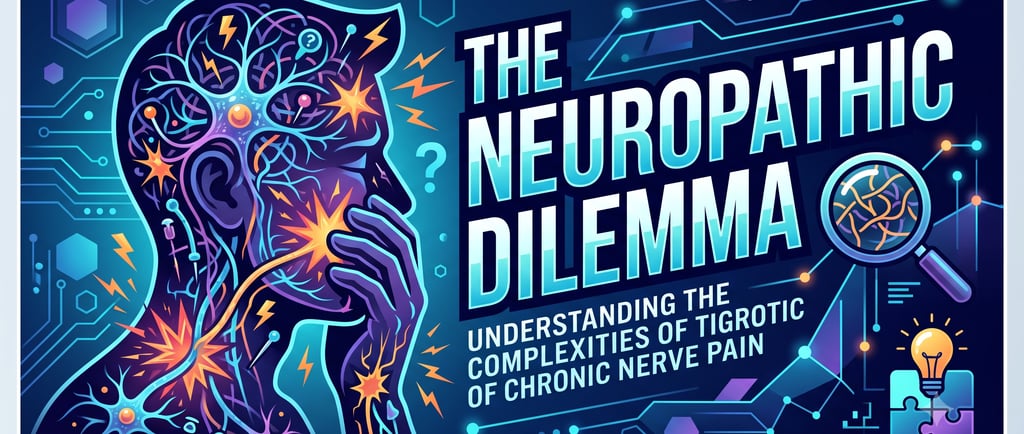
Neuropathic Dilemma
Imagine waking up every day to a body that speaks in a language of false alarms. A simple bedsheet feels like a sheet of sandpaper. A cool breeze mimics ice-cold needles. A walk to the kitchen feels like stepping on shards of broken glass. This is the daily reality of neuropathy—a condition where the body’s alarm system glitches, firing off frantic danger signals when there is no actual danger. It’s exhausting, isolating, and deeply frustrating. But the physical pain is only half the battle. The true hurdle is The Neuropathic Dilemma: navigating a medical puzzle where the symptoms are invisible, the treatments are often a game of trial-and-error, and the road to answers feels completely obscured. If you’ve ever felt lost trying to explain your pain to the world, you aren’t alone. Let’s unpack why this condition is so uniquely challenging—and how to start finding your footing again.
7/21/20266 min read
The Neuropathic Dilemma
If you live with chronic neuropathic pain, you know it is more than just a physical sensation. It is an exhausting, invisible weight that colors every interaction, disrupts sleep, and limits your daily life.
For decades, the standard medical response to chronic, burning nerve pain has been a prescription pad. But for many, traditional options like opioid medications fail to deliver on their promise. Instead of long-term relief, they often bring a cycle of increasing tolerance, system-wide side effects, and heightened sensitivity to pain.
At New Hope Ketamine Clinic in Deer Park, Illinois, we approach chronic pain from a completely different medical perspective. Led by Dr. Khawari, our state-of-the-art center specializes in a highly targeted, evidence-based alternative: Intravenous (IV) Ketamine in combination with IV Lidocaine infusion.
The goal is not to mask your symptoms temporarily but to reshape the brain’s neural pathways, decreasing central sensitization and improving how your brain and body interpret and respond to pain.
The Neuropathic Dilemma: Why Opioids Fall Short
Opioids are incredibly powerful tools for short-term, chronic pain—such as immediately following a major surgery or a severe injury. However, when applied to chronic neuropathic (nerve) conditions, their long-term efficacy drops dramatically, often introducing a new set of clinical challenges.
1. The Trap of Physical Dependence and Tolerance
When you take opioid medications consistently, your body's opioid receptors gradually desensitize. Over time, you require higher doses to achieve the exact same level of pain relief. This is a normal, biological reality—not a moral failing. Even when taken exactly as a physician prescribes, long-term use alters your baseline physiology, creating physical dependence and potential withdrawal symptoms if a dose is missed.
2. Systemic Side Effects
The human body is dense with opioid receptors, not just in the central nervous system, but throughout the gastrointestinal tract and brainstem. Long-term use frequently results in persistent, quality-of-life-altering side effects:
Severe, chronic constipation
Profound daytime drowsiness and brain fog
Cognitive impairment that affects work and family life
Respiratory depression risks
3. Opioid-Induced Hyperalgesia (OIH)
Perhaps the most frustrating paradox of long-term opioid therapy is Opioid-Induced Hyperalgesia. Over time, high doses of opioids can actually cause the nervous system to become more sensitive to pain stimuli. The medication changes your central nervous system's processing pathways, amplifying pain signals rather than dampening them. Patients often end up experiencing more pain, in more areas of the body, even as their medication doses increase.
How Chronic Pain Rewires the Brain
Understanding the biological changes caused by chronic pain helps explain why alternative therapeutic approaches may be beneficial.
When you experience an injury, nerves send warning signals to your brain. This is a crucial survival mechanism. However, when pain becomes chronic, those nerve pathways fire continuously. Over months or years, the brain undergoes a process of negative neuroplasticity. It becomes highly efficient at processing pain signals, essentially leaving the "pain gate" wide open.
Eventually, the central nervous system enters a state of hyper-reactivity known as central sensitization. The brain can continue to perceive intense, burning, or shooting pain even after the original physical tissue injury has completely healed. The brain stops verifying whether the physical source of the pain is still active; it simply keeps repeating the signal.
The Science of Ketamine Infusion Therapy for Pain
Ketamine was originally developed decades ago as a safe, reliable surgical anesthetic. However, modern neuroscientific research has revealed that when delivered at precise, low, sub-anesthetic doses via intravenous (IV) infusion, it behaves completely different. It acts as a powerful anti-inflammatory as well as it helps with pain by it neural reset mechanism.
Unlike opioids, which target the body's mu-opioid receptors, ketamine acts primarily as an antagonist at the NMDA (N-methyl-D-aspartate) receptors in the brain and spinal cord.
NMDA receptors act like volume knobs for pain signals in the central nervous system. When these receptors are chronically over-stimulated, they amplify pain. By temporarily blocking the NMDA receptor, ketamine acts as a circuit breaker. It halts the relentless cascade of pain signals, giving the over-stimulated nervous system a vital chance to reset its baseline.
Additionally, low-dose ketamine initiates a neuro-regenerative process. It helps to repair damaged neural connections and form healthy, adaptive pathways, effectively helping the brain "unlearn" its chronic pain behaviors.
Combined Therapy: A Multimodal Approach to Pain Relief
At New Hope Ketamine Clinic, we do not rely on a single, isolated mechanism for complex pain conditions. For patients dealing with severe chronic pain disorders, we offer IV Ketamine in combination with Lidocaine infusions.
By utilizing this multi-targeted approach, we achieve a powerful synergistic effect:
IV Ketamine: Focuses on the central nervous system, resetting overactive NMDA receptors and reducing the brain’s perception of central sensitization.
Lidocaine: Works primarily as a sodium channel blocker, stabilizing overactive or damaged peripheral nerve membranes throughout the body to stop pain signals at the source.
By attacking chronic nerve pain from both the peripheral nerves and the brain simultaneously, this therapeutic combination provides a comprehensive, non-opioid alternative that keeps the treatment exceptionally safe, deeply effective, and entirely free of opioid-related dependency risks.
Clear Advantages of New Hope Ketamine Therapy Over Traditional Care
Non-Addictive in Clinical Settings: When administered infrequently in an optimized clinical environment under expert supervision, IV ketamine does not trigger the compulsive use or severe physical dependency profiles associated with daily opioid prescriptions.
Lasting, Cumulative Relief: Rather than providing a temporary 4-12 hours window of relief like a pill, chronic pain patients treated with an initial series of infusions can experience reduced pain symptoms for several weeks to several months, in some cases up to 11 months, though the duration of relief can vary significantly from person to person.
Dual Action on Mood and Pain: Chronic pain and depression frequently share the same neural pathways, creating a frustrating cycle. Because ketamine promotes neuroplasticity, it simultaneously addresses the depressive symptoms, PTSD, and anxiety that so often accompany long-term physical suffering. Over 75% of patients with mood disorders find relief at our clinic.
No Increased Sensitivity: Ketamine does not cause hyperalgesia. It works to systematically turn down the nervous system's volume knob, rather than risking an increase in long-term pain sensitivity.
Is Ketamine Therapy Right for You?
Our non-opioid pain protocols are developed to help individuals struggling with a wide array of treatment-resistant, neuropathic, and inflammatory conditions. Patients who find significant relief with our protocols include those diagnosed with:
Complex Regional Pain Syndrome (CRPS)
Neuropathic Pain such as
post-herpetic neuralgia
Diabetic neuropathy
Cancer pain
Fibromyalgia
Chronic migraines and Cluster Headaches
Individuals currently dependent on high-dose painkillers seeking an exit strategy
Setting Realistic Intentions: Addressing Structural vs. Functional Pain
It is vital to distinguish between structural problems and functional nerve signaling. If your chronic pain is caused by an unresolved, structural issue—such as a severely herniated disc compressing a spinal nerve cell, a structural joint deformity, or a fresh bone fracture—that physical cause must be evaluated and treated by appropriate surgical or orthopedic specialists.
Ketamine cannot repair a torn ligament or a broken bone. However, once those structural issues are addressed, or if you are dealing with chronic, long-term nerve pain where the tissue has healed but the pain signals refuse to stop, our therapy can help quiet those lingering, hyper-reactive pathways.
What to Expect During Your Care
Taking a new step in your medical journey can feel overwhelming, especially if other treatments have disappointed you. We design our clinical care process at New Hope Ketamine Clinic to be transparent, supportive, and completely comfortable.
Step 1: No-Cost Consultation
Your journey begins by scheduling a consultation with our medical professionals.
We thoroughly discuss your medical history, current symptoms, and answer all questions to ensure ketamine therapy is an appropriate and safe option for you--- all at no cost
Step 2: Preparing for Your Session
On the day of your infusion, you must not eat for 4 hours or drink for 2 hours prior to your appointment time
You must also have a designated escort to drive you home safely after the session
Step 3: The Infusion Experience
Your treatment takes place in a calm, quiet, and fully supervised medical environment.
While you sit or lie down comfortably, our anesthesiology team administers the IV
infusion. You will remain awake and deeply relaxed throughout the process,, but will experience a dissociative state depending on the dosage
Patients are provided with noise cancelling headphones, soothing music and an eye mask to help create a deeply relaxing experience.
Your vital signs—including blood pressure, heart rate, and oxygen levels—are continuously monitored by healthcare provider.
Step 4: Long-Term Maintenance
Short-term side effects are mild and generally subside within a day. While many people notice improvements in mood or pain within hours to days, the most durable physical and emotional benefits develop through a structured series of initial sessions and are maintained over time as needed to support long-term quality of life.
Reclaim Your Quality of Life
You do not have to accept a life managed by the limitations of opioid medications. If you are ready to explore an evidence-based, non-opioid alternative that targets the neurological roots of chronic neuropathic pain, our team is here to guide you forward.
Contact New Hope Ketamine Clinic today at (847) 232-4045 to schedule your consultation. You can also visit our state-of-the-art facility at 21660 W Field Pkwy, Suite 301, Deer Park, IL 60010, or learn more online at www. NewHopeInfusion.com.
Contact Us
21660 W Field Pkwy
Suite 301
Deer Park, IL 60010
Phone:
847-232-4045
Fax:
847-232-4042
Email:
info@newhopeinfusion.com
Treatments
Disclaimer
© 2024. All rights reserved.
Pages
Hours of Operation
Monday 9:00am- 5:00pm
Wednesday 9:00am- 5:00pm
If you or someone you care about is currently facing a crisis, we strongly urge you to contact the National Suicide Prevention Lifeline at 800-273-8255 or call 911 for immediate assistance.